What Is Session Fixation: How Attackers Hijack Active Logins
Session fixation lets an attacker assign a known identifier to a user, turning a standard login into a shared key that bypasses authentication checks entirely.

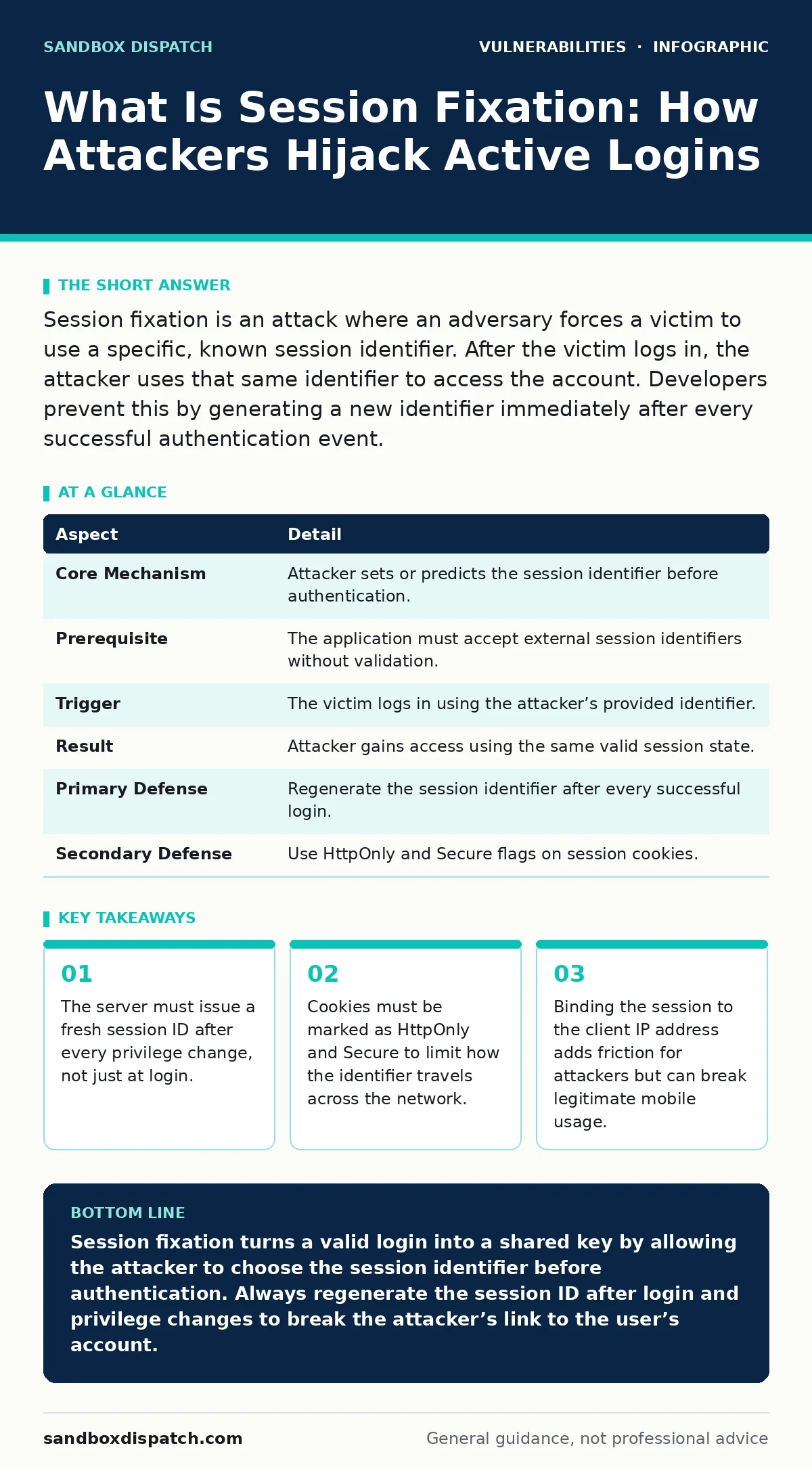
Session fixation is an attack where an adversary forces a victim to use a specific, known session identifier. After the victim logs in, the attacker uses that same identifier to access the account. Developers prevent this by generating a new identifier immediately after every successful authentication event.
The Sticky Note Analogy
Imagine you hand a stranger a sticky note with a room number written on it. You tell them, "Wait in the lobby." Later, you enter that room and lock the door. The stranger still holds the note with the correct room number. If the building security only checks the note and not who is holding it, the stranger walks in right behind you. Session fixation works by handing the attacker the note before you ever enter the room.
| Aspect | Detail |
|---|---|
| Core Mechanism | Attacker sets or predicts the session identifier before authentication. |
| Prerequisite | The application must accept external session identifiers without validation. |
| Trigger | The victim logs in using the attacker’s provided identifier. |
| Result | Attacker gains access using the same valid session state. |
| Primary Defense | Regenerate the session identifier after every successful login. |
| Secondary Defense | Use HttpOnly and Secure flags on session cookies. |
What Is Session Fixation
What is session fixation? It is a technique where an attacker establishes a valid session identifier with a web application and then tricks a legitimate user into using that same identifier. The server treats the identifier as unique to one user, but the attacker already knows it. When the victim authenticates, the server binds their credentials to that known identifier.
The attacker now shares the session. They do not need to steal the password. They do not need to intercept traffic after the login. They simply wait for the victim to activate the key the attacker planted. This differs from session hijacking, where the attacker steals an identifier after it has been created. In fixation, the attacker creates or chooses the identifier from the start.
How The Attack Unfolds
The process relies on the application’s trust in incoming session data. Most web frameworks allow a client to send a session ID in a cookie or a URL parameter. If the server accepts this value without verifying that it was generated by itself, the door is open. The attacker first obtains a valid session ID from the target application. They might do this by logging in with a dummy account and copying the ID, or by guessing the ID if the generation algorithm is weak.
Next, the attacker delivers this ID to the victim. They might send a link containing the ID as a parameter. They might use a cross-site scripting flaw to overwrite the victim’s cookie. The victim clicks the link or visits the page. Their browser stores the attacker’s ID. The victim then logs in. The server sees the login request coming with that specific ID. It associates the victim’s high-privilege account with that ID. The attacker, holding the same ID, now has access to the victim’s account.
Who Is At Risk
Any web application that manages user state is vulnerable. E-commerce sites, banking portals, and internal enterprise tools are primary targets because they hold sensitive data. The risk is highest when the application allows session IDs to be set via URL parameters. This practice is common in older frameworks or when developers try to make links bookmarkable. Applications that do not enforce secure cookie attributes are also at risk.
If a cookie lacks the Secure flag, it can be sent over unencrypted HTTP, making it easier for an attacker to inject their own ID via a man-in-the-middle attack. If it lacks the HttpOnly flag, JavaScript on the page can read and modify the cookie, allowing cross-site scripting to facilitate the fixation. Users on public Wi-Fi networks face higher exposure because attackers on the same network can more easily inject malicious cookies or redirect traffic.
What People Usually Get Wrong
Developers often believe that using complex, random session IDs is enough. They generate long, unpredictable strings and assume an attacker cannot guess them. This misses the point of session fixation. The attacker does not need to guess the ID. They need the application to accept an ID they provide. Even a 256-bit random ID is vulnerable if the server accepts it from the client before authentication. Another common mistake is regenerating the session ID only at the initial login.
Applications often allow users to change roles or access higher-privilege sections without re-authenticating. If the session ID remains the same, an attacker who fixed the session during the low-privilege phase retains access after the privilege escalation. A third error is relying solely on IP binding. While tying a session to an IP address can stop an attacker on a different network, it breaks functionality for users on mobile networks or behind NAT gateways, where the IP changes frequently. This leads developers to disable IP binding, leaving the application exposed.
How To Prevent Session Fixation
The primary defense is strict session management. The server must generate the session identifier internally. It must never accept a session ID from the client before the user has authenticated. If a client sends an ID, the server should ignore it and issue a new one. After the user successfully logs in, the server must invalidate the old session and create a new one. This breaks the link between the pre-login state and the post-login state. The attacker’s known ID becomes useless. This regeneration must happen after every privilege change, not just at login. If a user moves from a guest role to an admin role, a new ID is required.
Cookies must be configured with the HttpOnly and Secure flags. HttpOnly prevents JavaScript from accessing the cookie, mitigating cross-site scripting attacks that could steal or fixate the ID. Secure ensures the cookie is only sent over HTTPS, preventing interception on unencrypted connections. Domain and path attributes should be set to the most restrictive values possible. This limits which parts of the application can access the cookie. If you use subdomains, ensure the session cookie is not accessible to all of them unless necessary. This reduces the attack surface if one subdomain is compromised.
Integrating With Broader Security Practices
Session fixation is rarely an isolated failure. It often serves as the entry point for more complex exploits. An attacker might use session fixation to gain a foothold, then exploit broken access control to move laterally within the application. Understanding how these vulnerabilities chain together is vital for effective defense. When conducting attack surface management, treat session handling as a critical component. Every endpoint that accepts or returns session data should be reviewed. Risk-based vulnerability management should prioritize session-related flaws because they directly compromise user identity.
While patch management addresses software bugs, session fixation is often a configuration or design flaw. It requires code review and architectural changes, not just software updates. Browser updates help by fixing client-side vulnerabilities that could facilitate the fixation, but they do not fix the server’s acceptance of external IDs. Unpatched software may contain known session management flaws, so keeping dependencies current is necessary but not sufficient. A high CVSS score often reflects the ease of exploitation and the impact of account takeover, making session fixation a high-priority fix.
Implementation Checklist
- Disable session ID transmission via URL parameters.
- Enforce HttpOnly and Secure flags on all session cookies.
- Regenerate session ID after every successful authentication.
- Regenerate session ID after any privilege escalation.
- Validate that the server generates all session identifiers internally.
- Restrict cookie domain and path to the minimum required scope.
Key takeaways
- The server must issue a fresh session ID after every privilege change, not just at login.
- Cookies must be marked as HttpOnly and Secure to limit how the identifier travels across the network.
- Binding the session to the client IP address adds friction for attackers but can break legitimate mobile usage.
Session fixation turns a valid login into a shared key by allowing the attacker to choose the session identifier before authentication. Always regenerate the session ID after login and privilege changes to break the attacker’s link to the user’s account.
Frequently asked questions
Does HTTPS stop session fixation?
No. HTTPS encrypts data in transit, but it does not prevent an attacker from setting a cookie or URL parameter before the user logs in. The server still accepts the attacker’s ID.
Can I use IP binding to fix this?
IP binding adds a layer of defense but is not a complete fix. It breaks functionality for mobile users and those behind NAT. It should be used only in conjunction with session regeneration.
Is this different from cross-site scripting?
Yes. XSS is a method to inject code. Session fixation is the goal of stealing or controlling a session. XSS can be used to facilitate fixation, but fixation can also occur via social engineering or URL manipulation.
Do modern frameworks prevent this automatically?
Many modern frameworks regenerate IDs on login by default, but not all. You must verify your framework’s configuration and ensure it does not accept external session IDs before authentication.
How this guide was produced: written by the Sandbox Dispatch editorial team with AI assistance, checked against the public references listed below, and reviewed when the facts change. See our editorial policy or report an error.