Difference Between Data Scraping and Web Scraping
Web scraping is a method of extraction, while data scraping is a broad category that includes web sources, databases, and APIs.
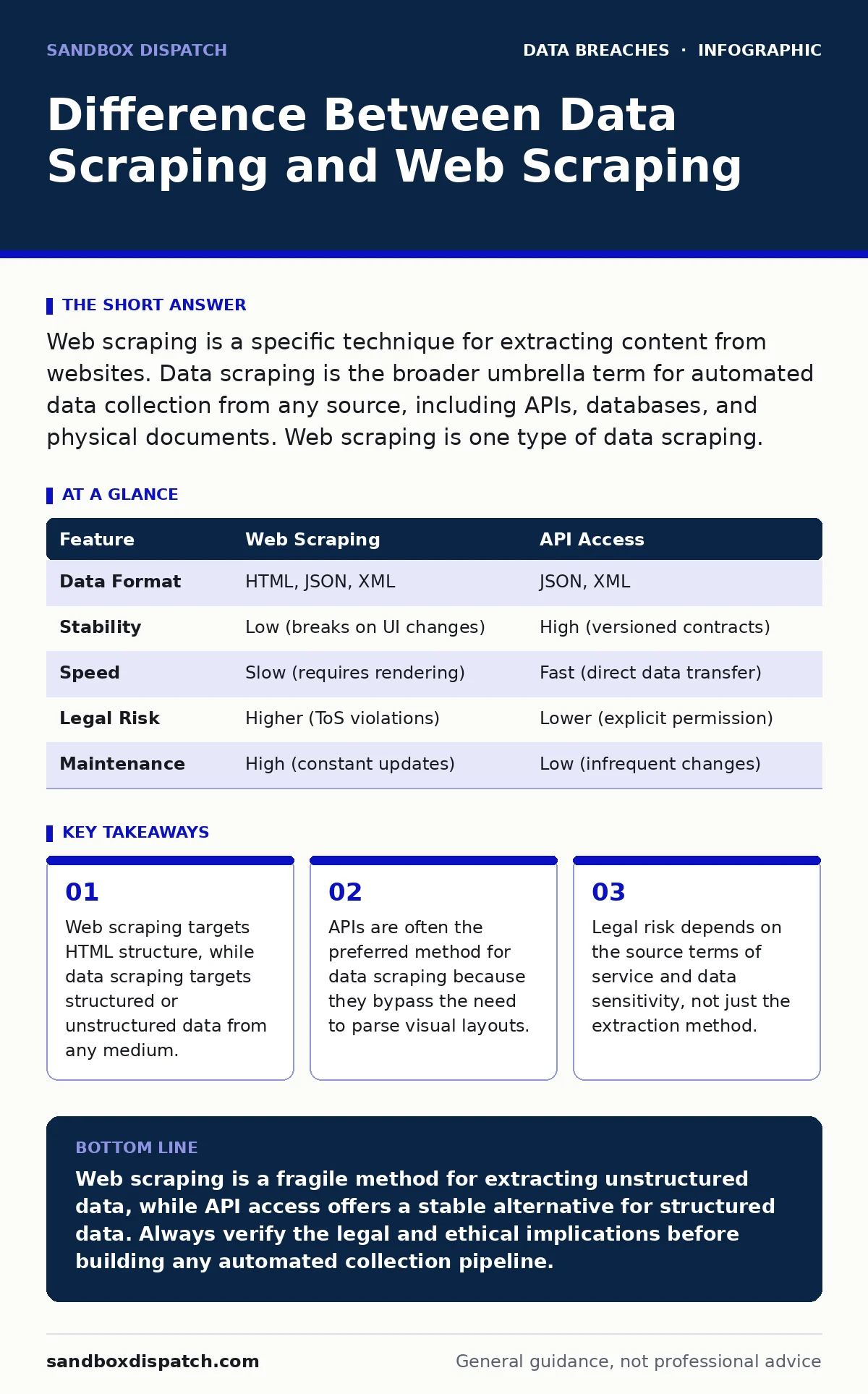
Web scraping is a specific technique for extracting content from websites. Data scraping is the broader umbrella term for automated data collection from any source, including APIs, databases, and physical documents. Web scraping is one type of data scraping.
What is the difference between data scraping and web scraping?
Data scraping is the broad practice of automatically collecting information from any source, whereas web scraping is a specific subset that targets websites. Web scraping involves sending HTTP requests to servers and parsing the returned HTML or JavaScript to extract visible content. Data scraping encompasses this but also includes pulling records from databases, querying public APIs, and even using optical character recognition on scanned documents. You use web scraping when your target is exclusively the open web. You use data scraping when you need to aggregate information from mixed sources, such as combining website prices with internal sales logs.
Why do developers prefer APIs over web scraping?
APIs provide structured data in predictable formats like JSON or XML, which eliminates the need to parse complex HTML layouts. Web scraping requires you to write selectors that match specific DOM elements, which break whenever the website redesigns its interface. APIs offer a stable contract between the provider and the consumer. When you scrape a website, you are reverse-engineering a user interface designed for humans, not machines. This creates a hidden maintenance cost where your scripts fail silently during minor frontend updates. APIs are designed for machine-to-machine communication, making them more reliable for long-term data pipelines.
How does bot detection impact scraping efforts?
Modern websites deploy bot detection mechanisms that analyze request patterns, browser fingerprints, and mouse movements to distinguish humans from scripts. These systems can block IP addresses, present CAPTCHAs, or serve empty pages to suspected bots. Web scraping tools often mimic human behavior by adding random delays and rotating user-agent strings.
However, this cat-and-mouse game increases latency and computational overhead. Data scraping via APIs usually includes authentication tokens that identify the client explicitly, bypassing behavioral analysis. Relying on web scraping for critical data introduces fragility, as the target site can change its detection logic at any time without notice.
What are the legal boundaries of scraping public data?
Accessing publicly available information does not automatically grant the right to scrape it. Website terms of service often explicitly prohibit automated access, and violating these terms can lead to legal action or IP bans. The legal landscape varies by jurisdiction, but unauthorized access to protected systems is generally prohibited. Scraping sensitive personal data or protected health information carries severe penalties under regulations like the HIPAA Security Rule. Even if data is public, aggregating it in a way that competes with the original source can trigger litigation. Always review the robots.txt file and terms of service before initiating any scraping activity.
How do you handle dynamic content in web scraping?
Many modern websites load content dynamically using JavaScript frameworks, meaning the initial HTML response contains little to no useful data. Traditional HTTP clients cannot execute JavaScript, so they return empty shells. To scrape dynamic content, you must use headless browsers that render the page fully before extraction. This approach is slower and more resource-intensive than static parsing. It also requires managing browser instances and handling asynchronous network requests. If the site offers an API, using that endpoint is far more efficient than rendering the entire page. Dynamic scraping increases the complexity of your pipeline and the likelihood of being detected as a bot.
| Feature | Web Scraping | API Access |
|---|---|---|
| Data Format | HTML, JSON, XML | JSON, XML |
| Stability | Low (breaks on UI changes) | High (versioned contracts) |
| Speed | Slow (requires rendering) | Fast (direct data transfer) |
| Legal Risk | Higher (ToS violations) | Lower (explicit permission) |
| Maintenance | High (constant updates) | Low (infrequent changes) |
See also: Data Privacy vs Security: How to Choose the Right Control · How Cloud Storage Misconfigurations Leak Data Step by Step
Why is data inventory and mapping critical for scraped data?
Scraped data is often messy, incomplete, or inconsistent. Without a clear data inventory and mapping strategy, you cannot trust the integrity of your pipeline. You must define how each field from the source maps to your internal schema. This process reveals gaps where the source lacks required attributes. It also helps identify sensitive personal data that requires special handling or anonymization. Proper mapping ensures that your downstream applications receive clean, structured input. Neglecting this step leads to silent data corruption, where bad records propagate through your system without detection.
How do you mitigate the risk of misconfigured cloud storage leaks?
When storing scraped data, organizations often use cloud storage buckets. Misconfigured cloud storage leaks occur when these buckets are set to public access, exposing sensitive information to anyone on the internet. You must enforce strict access controls and encryption at rest for all scraped data. Regular audits of storage permissions prevent accidental exposure. If you scrape sensitive data, you must also ensure that your storage solution complies with relevant privacy regulations. Failing to secure the storage layer negates the security of the scraping process itself.
What are the ethical implications of scraping user data?
Scraping user-generated content raises ethical questions about consent and privacy. Even if data is public, users may not expect their information to be harvested and repurposed. Aggregating data from multiple sources can create detailed profiles of individuals, violating their reasonable expectation of privacy. You should consider the impact of your scraping activities on the target community. Overloading servers with requests can degrade service for legitimate users. Ethical scraping involves respecting rate limits, honoring opt-out requests, and avoiding the collection of sensitive personal data without explicit permission.
How do you maintain a scalable scraping pipeline?
Scalability requires handling increased volume without compromising stability or legality. You must implement rate limiting to avoid overwhelming target servers. Use distributed systems to parallelize requests, but ensure each node respects the target's capacity. Monitor for changes in the target website's structure and update your selectors accordingly. Incorporate error handling and retry logic for transient failures. Regularly review your data retention policies to ensure you are not storing more data than necessary. A scalable pipeline is not just about speed; it is about resilience and compliance over time.
Key takeaways
- Web scraping targets HTML structure, while data scraping targets structured or unstructured data from any medium.
- APIs are often the preferred method for data scraping because they bypass the need to parse visual layouts.
- Legal risk depends on the source terms of service and data sensitivity, not just the extraction method.
Web scraping is a fragile method for extracting unstructured data, while API access offers a stable alternative for structured data. Always verify the legal and ethical implications before building any automated collection pipeline.
Frequently asked questions
Is web scraping illegal?
Web scraping itself is not illegal, but violating terms of service or accessing protected systems can lead to legal consequences. Always review the target site's policies.
Can I scrape social media data?
Most social media platforms explicitly prohibit scraping in their terms of service. Using their official APIs is the recommended and legal approach.
How do I avoid getting blocked?
Implement rate limiting, rotate user agents, and respect the robots.txt file. Consider using official APIs if available to avoid detection mechanisms.
What is the best tool for web scraping?
There is no single best tool. The choice depends on the complexity of the site, the volume of data, and your technical expertise. Headless browsers are often necessary for dynamic content.
How this guide was produced: written by the Sandbox Dispatch editorial team with AI assistance, checked against the public references listed below, and reviewed when the facts change. See our editorial policy or report an error.