HIPAA Security Rule vs Privacy Rule: The Distinct Compliance Paths
The Privacy Rule governs who may access data, while the Security Rule mandates the technical controls that prevent unauthorized access to that data.
The HIPAA Privacy Rule defines who may use or disclose health information and under what conditions. The HIPAA Security Rule specifies the administrative, physical, and technical safeguards required to protect electronic data. One rules behavior; the other enforces infrastructure.
HIPAA Security Rule vs Privacy Rule Difference
The core distinction lies in scope and mechanism. The Privacy Rule establishes the rights of individuals and the duties of covered entities regarding the use and disclosure of protected health information. It answers the question of who may see the data. The Security Rule focuses exclusively on electronic protected health information and dictates how systems must be configured to keep that data safe. It answers the question of how the data is secured. One is a policy framework; the other is an implementation standard.
What Is the Privacy Rule
The Privacy Rule creates national standards for the protection of individually identifiable health information. It applies to covered entities and their business associates. This rule defines what constitutes protected health information, including demographic data, medical histories, and payment information. It grants patients specific rights, such as the ability to access their records and request corrections. The rule also sets limits on how this data can be shared without patient authorization. It covers data in any form: paper, oral, or electronic.
What Is the Security Rule
The Security Rule complements the Privacy Rule by focusing on technical safeguards. It applies only to electronic protected health information that is created, received, maintained, or transmitted by covered entities. This rule mandates three categories of safeguards: administrative, physical, and technical. Administrative safeguards involve workforce security and risk analysis. Physical safeguards control facility access and device handling. Technical safeguards include access controls, audit controls, and transmission security. The goal is to ensure the confidentiality, integrity, and availability of the data.
Point-by-Point Comparison
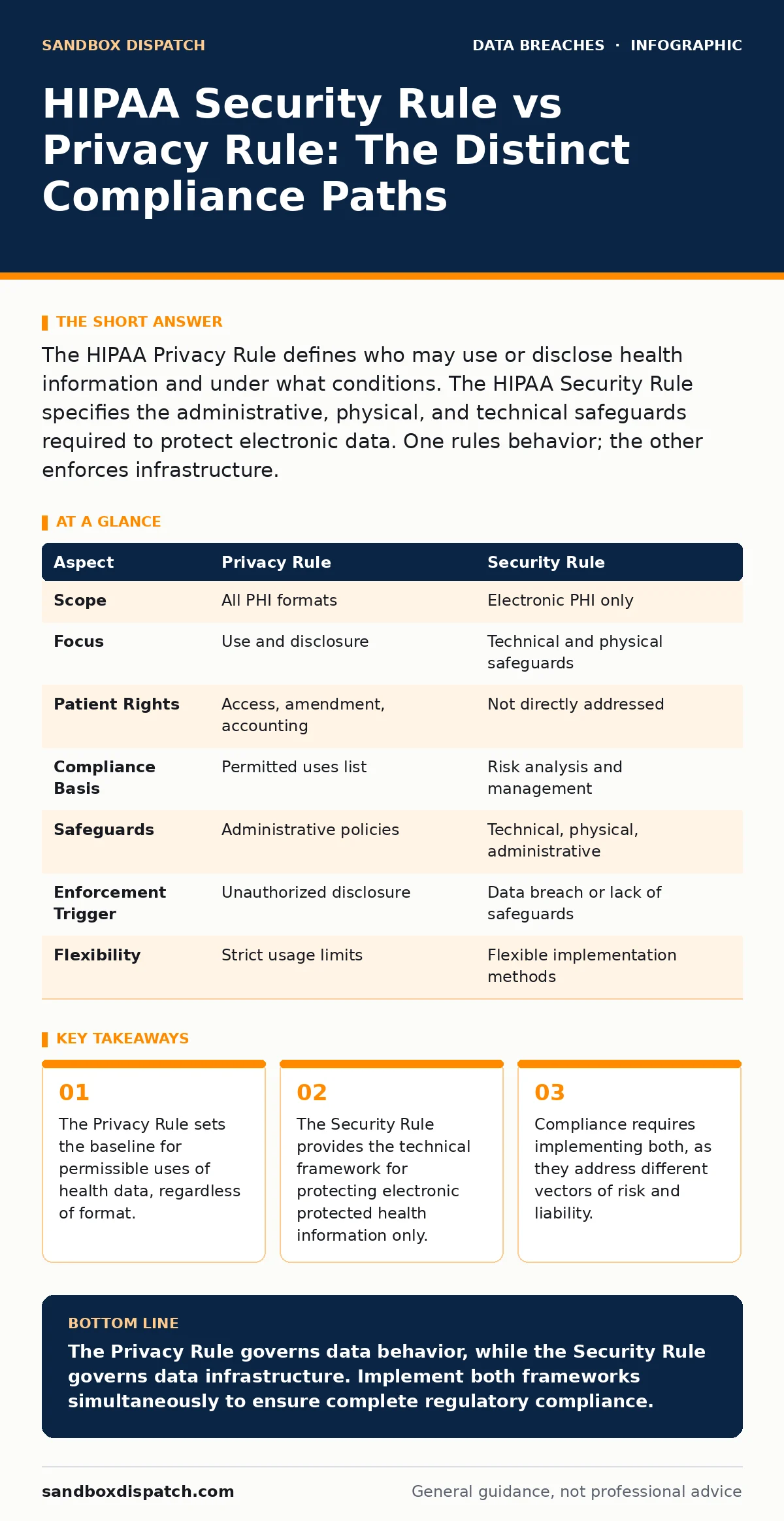
| Aspect | Privacy Rule | Security Rule |
|---|---|---|
| Scope | All PHI formats | Electronic PHI only |
| Focus | Use and disclosure | Technical and physical safeguards |
| Patient Rights | Access, amendment, accounting | Not directly addressed |
| Compliance Basis | Permitted uses list | Risk analysis and management |
| Safeguards | Administrative policies | Technical, physical, administrative |
| Enforcement Trigger | Unauthorized disclosure | Data breach or lack of safeguards |
| Flexibility | Strict usage limits | Flexible implementation methods |
When To Choose The Privacy Rule
Choose the Privacy Rule as your primary reference when defining organizational policies. It is the correct framework for determining whether a specific use of data is permissible. You rely on this rule when handling patient requests for records. It guides decisions on sharing data with business associates. It is the basis for training staff on appropriate conduct. It applies when managing paper records or verbal conversations. It is the standard for consent forms and notice of privacy practices.
- Define permissible uses of data
- Manage patient access requests
- Handle paper and oral records
See also: Sensitive Personal Data: Small Business Protection Tactics · Audit Logging Best Practices for Secure Systems
When To Choose The Security Rule
Choose the Security Rule when designing or auditing your IT infrastructure. It is the correct framework for configuring network access controls. You rely on this rule when selecting encryption standards for data at rest and in transit. It guides decisions on multi-factor authentication and audit logging. It applies when securing mobile devices and workstations. It is the basis for incident response plans related to technical failures. It ensures that the systems holding data are resilient against intrusion.
- Configure encryption and access controls
- Implement audit logging procedures
- Secure physical workstations
Where They Overlap
Both rules require a thorough risk analysis. They both mandate workforce training, though the content differs. They both require written policies and procedures. They both hold business associates accountable for compliance. The overlap is most visible in incident response. A breach triggers obligations under both rules. You must notify patients under the Privacy Rule and report to authorities under the Security Rule. Understanding this intersection prevents gaps in your compliance program. Ignoring one while focusing on the other creates significant liability.
Common Implementation Mistakes
Organizations often treat these rules as separate compliance silos. This separation creates vulnerabilities. For example, a system may meet Security Rule encryption standards but violate Privacy Rule disclosure limits. Staff may understand technical controls but ignore policy constraints. Another common error is neglecting employee offboarding security. Revoking access is a Security Rule requirement, but failing to update policy records is a Privacy Rule violation. Misconfigured cloud storage leaks often result from ignoring the intersection of these two frameworks.
Maintaining Continuous Compliance
Compliance is not a one-time achievement. It requires ongoing monitoring and adjustment. Regular audits help identify drift from established standards. You must update policies when technology changes. You must retrain staff when regulations evolve. Data retention policies must align with both rules. User access provisioning must follow the principle of least privilege. By integrating these rules into your daily operations, you reduce the risk of non-compliance. This integrated approach ensures that your data remains protected and your organization remains accountable.
Key takeaways
- The Privacy Rule sets the baseline for permissible uses of health data, regardless of format.
- The Security Rule provides the technical framework for protecting electronic protected health information only.
- Compliance requires implementing both, as they address different vectors of risk and liability.
The Privacy Rule governs data behavior, while the Security Rule governs data infrastructure. Implement both frameworks simultaneously to ensure complete regulatory compliance.
Frequently asked questions
Does the Security Rule apply to paper records?
No, the Security Rule applies only to electronic protected health information. Paper records are governed solely by the Privacy Rule and physical safeguard requirements.
Who is responsible for HIPAA compliance?
Covered entities and their business associates are responsible. This includes healthcare providers, health plans, and clearinghouses, as well as vendors who handle health data.
What is the penalty for non-compliance?
Penalties vary based on the level of negligence. They can range from thousands to millions of dollars per violation, with annual caps. Criminal penalties may also apply.
How often must risk analyses be performed?
Risk analyses should be performed regularly and whenever significant changes occur to the environment. There is no fixed schedule, but annual reviews are common practice.
How this guide was produced: written by the Sandbox Dispatch editorial team with AI assistance, checked against the public references listed below, and reviewed when the facts change. See our editorial policy or report an error.