Digital Forensics Misconceptions That Derail Incident Response
Most teams waste hours chasing false leads because they treat forensic data as absolute truth rather than a fragile reconstruction of past events.

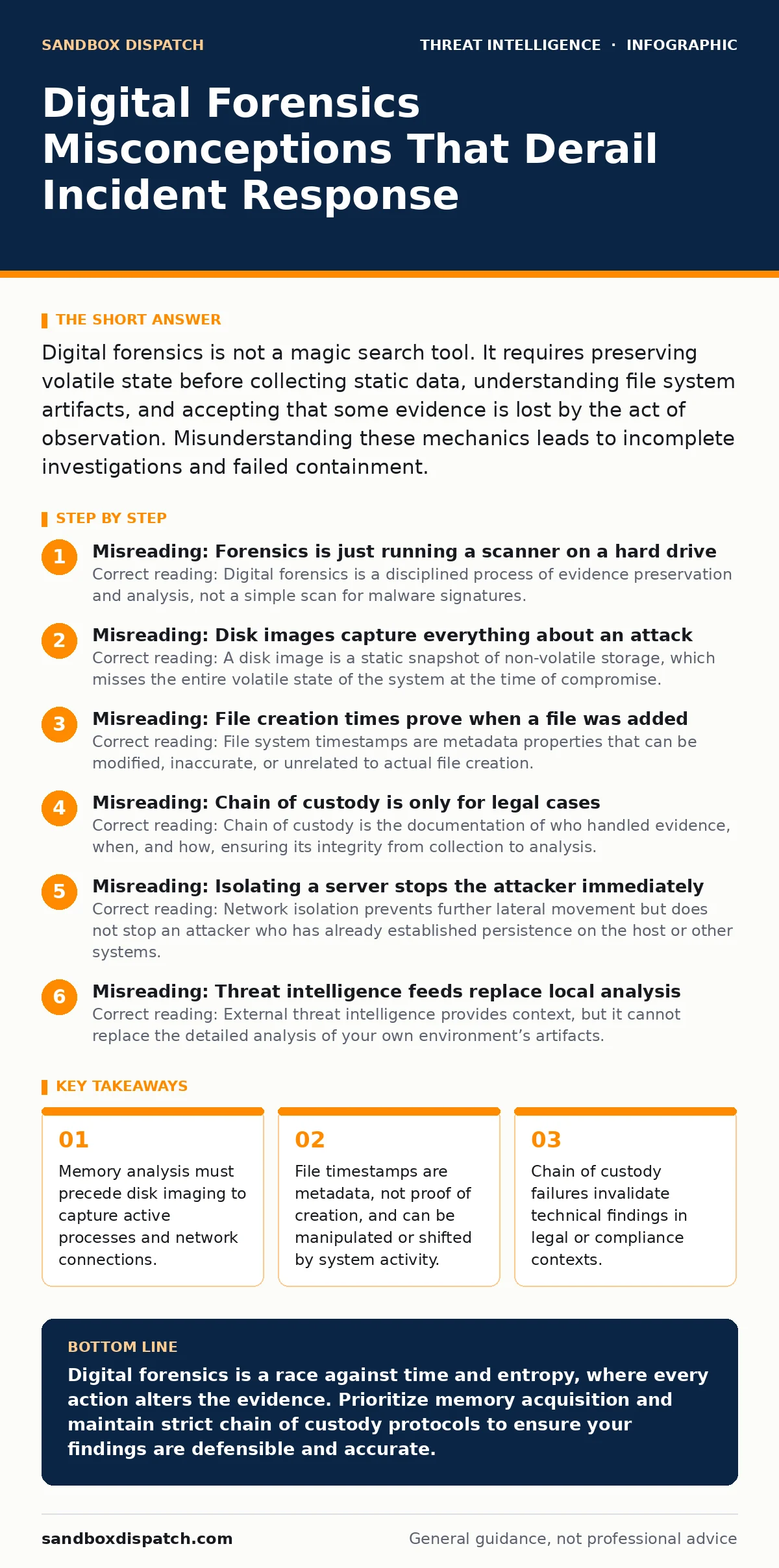
Digital forensics is not a magic search tool. It requires preserving volatile state before collecting static data, understanding file system artifacts, and accepting that some evidence is lost by the act of observation. Misunderstanding these mechanics leads to incomplete investigations and failed containment.
Misreading: Forensics is just running a scanner on a hard drive
Correct reading: Digital forensics is a disciplined process of evidence preservation and analysis, not a simple scan for malware signatures. Many practitioners treat incident response as a cleanup task, running antivirus tools and deleting files. This approach destroys the very evidence needed to understand the scope of the intrusion. You must secure the environment first. If you alter the system before capturing its state, you lose the ability to reconstruct the attacker's actions.
The primary goal is to determine what happened, not just to remove the threat. Antivirus tools often trigger on known signatures, leaving advanced persistent threats undetected. Furthermore, deleting files can trigger anti-forensic mechanisms embedded in some malware, causing data loss. A proper response begins with isolation. You disconnect the affected system from the network to prevent lateral movement. Then you capture the current state. This includes running processes, open network sockets, and registry keys. Only after this volatile data is secured do you image the hard drive.
Misreading: Disk images capture everything about an attack
Correct reading: A disk image is a static snapshot of non-volatile storage, which misses the entire volatile state of the system at the time of compromise. Modern attacks often reside in memory, using fileless techniques that leave no trace on the hard drive until persistence is established. If you wait to image the disk, the attacker’s code may have already executed and cleared itself from RAM.
You must prioritize memory acquisition. Memory contains decrypted credentials, encryption keys, and process injection details that are never written to disk. Tools that capture RAM can reveal hidden processes and network connections that the operating system hides from standard listing commands. This data is fleeting. Once the system reboots, this information is gone. Therefore, memory forensics is not an optional add-on; it is the first step in any serious investigation involving active threats.
Misreading: File creation times prove when a file was added
Correct reading: File system timestamps are metadata properties that can be modified, inaccurate, or unrelated to actual file creation. Most file systems track multiple timestamps, such as creation, modification, and access times. Attackers frequently use tools to manipulate these values, a technique known as anti-forensics. Additionally, operating system behaviors can shift these timestamps unexpectedly.
For example, copying a file might preserve the original creation time while updating the modification time. Restoring a file from backup might reset all timestamps. Relying on a single timestamp column in a file explorer provides a false sense of security. You must analyze the full set of metadata for each artifact. Cross-reference file system journals, such as the Master File Table on NTFS, with other system logs. These journals record low-level changes that user-space tools cannot easily spoof. Understanding the underlying file system structure is necessary to interpret these times correctly.
Misreading: Chain of custody is only for legal cases
Correct reading: Chain of custody is the documentation of who handled evidence, when, and how, ensuring its integrity from collection to analysis. Many technical teams dismiss this as administrative overhead relevant only to law enforcement. This is a dangerous error. Without a verifiable chain of custody, you cannot prove that the evidence you analyzed is the same evidence collected at the scene.
In internal investigations, this documentation protects your organization from claims of bias or tampering. If an employee challenges the findings, the absence of a clear audit trail undermines your credibility. You must hash every piece of evidence immediately upon collection. Cryptographic hashes, such as SHA-256, create a unique fingerprint of the data. Any alteration to the file, even a single bit, changes the hash. Recording these hashes at each transfer point ensures that the evidence remains trustworthy.
Misreading: Isolating a server stops the attacker immediately
Correct reading: Network isolation prevents further lateral movement but does not stop an attacker who has already established persistence on the host or other systems. Attackers often deploy multiple backdoors across the environment before detection. Isolating one server may alert the attacker to the compromise, causing them to trigger data exfiltration or self-destruct mechanisms on other systems.
You must assume the entire network is compromised until proven otherwise. This assumption drives the scope of your investigation. You check other systems for signs of the same indicators of compromise. You review authentication logs for unusual activity. You analyze DNS queries for communication with known command-and-control servers. This broad view is often covered in guides on attacker persistence techniques. Understanding how attackers maintain access helps you identify hidden entry points. Isolation is a containment step, not a resolution step.
See also: Jailbroken AI Response: Immediate Containment and Recovery Steps · Audit Logging Best Practices for Secure Systems
Misreading: Threat intelligence feeds replace local analysis
Correct reading: External threat intelligence provides context, but it cannot replace the detailed analysis of your own environment’s artifacts. Feeds offer generic indicators such as IP addresses or file hashes. These indicators have a high rate of false positives and a short lifespan. An IP address might be reassigned to a legitimate user within hours. A file hash might be shared by benign and malicious versions of a software library.
You must correlate external intelligence with internal data. This process reduces noise and highlights relevant threats. A guide on false positives in threat detection explains how to tune your alerts. Without local analysis, you waste resources investigating irrelevant hits. You use the intelligence to prioritize which logs to review. You look for specific patterns of behavior rather than just matching strings. This contextual approach turns raw data into actionable insight.
Misreading: You can recover deleted files with standard tools
Correct reading: File recovery is not guaranteed, especially on modern solid-state drives that use wear-leveling and secure erase features. Standard recovery tools work by scanning unallocated space for file signatures. This works on traditional spinning disks where data remains until overwritten. However, SSDs proactively erase blocks to maintain performance and lifespan.
Once a file is deleted on an SSD, the controller may immediately erase the physical cells. No software can recover data that has been physically cleared. You must understand the storage media involved. If the device supports secure erase, assume deleted data is unrecoverable. This limitation affects your incident response strategy. You cannot rely on recovering deleted malicious scripts or logs. You must collect evidence before deletion occurs. This is why memory and live system analysis are so critical.
Key takeaways
- Memory analysis must precede disk imaging to capture active processes and network connections.
- File timestamps are metadata, not proof of creation, and can be manipulated or shifted by system activity.
- Chain of custody failures invalidate technical findings in legal or compliance contexts.
Digital forensics is a race against time and entropy, where every action alters the evidence. Prioritize memory acquisition and maintain strict chain of custody protocols to ensure your findings are defensible and accurate.
Frequently asked questions
What is the first step in digital forensics?
The first step is isolation to prevent further damage, followed immediately by capturing volatile memory to preserve active processes and network connections.
Can I use free tools for incident response?
You can use open-source tools, but they require significant expertise to operate correctly. Professional environments often need validated toolchains to ensure evidence integrity.
How do I know if a file timestamp is fake?
You compare the file system metadata with system logs and journal entries. Discrepancies between the file’s recorded time and the system’s audit log suggest manipulation.
Is memory forensics always necessary?
For advanced threats, yes. Fileless malware and in-memory attacks leave no trace on disk, making memory analysis the only way to detect and understand the intrusion.
How this guide was produced: written by the Sandbox Dispatch editorial team with AI assistance, checked against the public references listed below, and reviewed when the facts change. See our editorial policy or report an error.