Configuration Hardening FAQs: Secure Defaults and Attack Surface Reduction
Most breaches exploit default settings rather than unknown code flaws, making configuration hardening the most effective defense against common attack vectors.

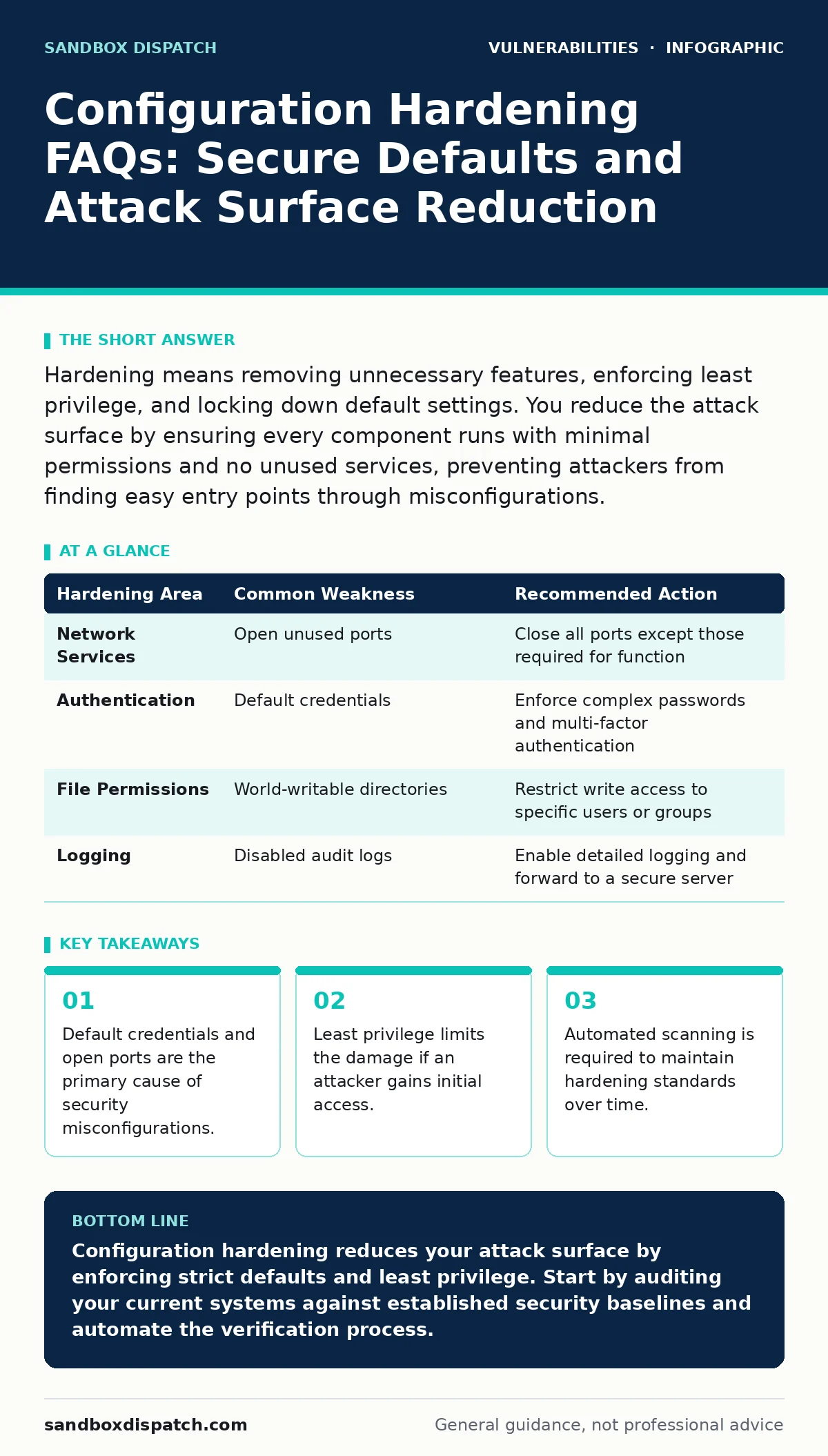
Hardening means removing unnecessary features, enforcing least privilege, and locking down default settings. You reduce the attack surface by ensuring every component runs with minimal permissions and no unused services, preventing attackers from finding easy entry points through misconfigurations.
What is configuration hardening?
Configuration hardening is the process of securing a system by reducing its attack surface through the removal of unnecessary components and the enforcement of strict security policies. You modify default settings to ensure that only required services run with the minimum necessary permissions. This practice prevents attackers from exploiting weak defaults or unused features that often remain active for convenience.
Why do default settings fail?
Default settings prioritize ease of setup and compatibility over security, leaving known vulnerabilities exposed by design. Manufacturers ship products with open ports and generic credentials to simplify initial deployment. You must change these defaults immediately because attackers scan for these known weaknesses automatically. Leaving them active is equivalent to leaving your front door unlocked.
How does least privilege work?
Least privilege is the principle that a user or process should have only the permissions required to perform its specific task. You grant access to the minimum set of resources needed, denying everything else by default. If an attacker compromises a service running with limited rights, they cannot easily move laterally to more sensitive systems. This containment strategy significantly reduces the impact of any single breach.
What is the principle of least functionality?
Least functionality means disabling all features, services, and applications that are not strictly necessary for the system's operation. You remove unused software, close unnecessary ports, and disable legacy protocols. Every active service is a potential entry point for exploit chains that attackers might use. By stripping away non-essential components, you eliminate entire categories of risk.
How do you manage secrets securely?
You should never store passwords, keys, or tokens in configuration files or source code. Use a dedicated secrets manager or environment variables that are injected at runtime. Hardcoded credentials often leak when repositories are exposed or logs are accessed. Rotating secrets regularly and restricting access to them ensures that compromised credentials remain useless after a short window.
What are security baselines?
Security baselines are standardized sets of security configurations that define the minimum security posture for a system type. You apply these baselines consistently across all instances to ensure uniform protection. They serve as a reference point for auditing and compliance, making it easier to detect deviations. Using established frameworks helps you avoid missing critical hardening steps.
How do you verify hardening effectiveness?
You must use automated tools to continuously scan configurations against your defined baselines. Manual checks are prone to error and do not scale well in dynamic environments. These tools detect drift, where configurations change over time and become less secure. Regular verification ensures that your hardening efforts remain effective as systems evolve.
| Hardening Area | Common Weakness | Recommended Action |
|---|---|---|
| Network Services | Open unused ports | Close all ports except those required for function |
| Authentication | Default credentials | Enforce complex passwords and multi-factor authentication |
| File Permissions | World-writable directories | Restrict write access to specific users or groups |
| Logging | Disabled audit logs | Enable detailed logging and forward to a secure server |
Why is patching not enough?
Patch management addresses known vulnerabilities in software code, but it does not fix insecure configurations. A fully patched system can still be compromised if it runs with excessive privileges or open ports. You must harden configurations independently of patching cycles. Both measures are necessary to defend against different types of threats.
How does this relate to other risks?
Misconfigurations often serve as the initial foothold for more complex attacks. Attackers might use a misconfigured service to gain access and then exploit SQL injection flaws in connected databases. Proper hardening reduces the likelihood of these initial breaches. It also limits the effectiveness of privilege escalation vulnerabilities by ensuring that even if code is exploited, the resulting permissions are minimal.
What about IoT devices?
IoT device vulnerabilities are often exacerbated by poor configuration practices, such as unchangeable default passwords. These devices frequently lack the resources for complex security measures, making hardening even more critical. You should segment IoT devices on separate networks to limit their impact if compromised. Understanding attack vectors in CVSS helps you prioritize which configurations to lock down first.
How do you maintain hardening over time?
You must integrate configuration checks into your deployment pipeline to catch issues before they reach production. Continuous monitoring detects changes that deviate from your security baselines. This approach ensures that new deployments adhere to the same standards as existing systems. Regular reviews of your policies help you adapt to new threats and technologies.
What is the role of documentation?
Clear documentation of your security policies and configuration standards ensures consistency across your team. It provides a reference for new employees and helps during incident response. You should document the rationale behind each hardening decision to facilitate future audits. Good documentation reduces the risk of accidental misconfigurations during maintenance.
How do you handle legacy systems?
Legacy systems often cannot be updated to modern security standards, making hardening their only viable defense. You should isolate these systems from the rest of your network and restrict access strictly. Implementing additional monitoring can help detect unauthorized access attempts. Understanding the limitations of these systems helps you mitigate risk without full replacement.
What is the cost of not hardening?
The cost of not hardening includes increased risk of breach, potential data loss, and regulatory penalties. Misconfigurations are a leading cause of security incidents, often easier to exploit than code vulnerabilities. Investing in hardening reduces the likelihood of these incidents significantly. It is a proactive measure that pays off by preventing costly breaches.
How does this fit with vulnerability disclosure?
A robust vulnerability disclosure policy encourages reporters to find and report configuration issues safely. You should include configuration hardening guidelines in your public security documentation. This transparency helps the community understand your security posture. It also builds trust with users and partners by demonstrating your commitment to security.
Key takeaways
- Default credentials and open ports are the primary cause of security misconfigurations.
- Least privilege limits the damage if an attacker gains initial access.
- Automated scanning is required to maintain hardening standards over time.
Configuration hardening reduces your attack surface by enforcing strict defaults and least privilege. Start by auditing your current systems against established security baselines and automate the verification process.
Frequently asked questions
How often should I review my configurations?
Review configurations continuously through automated tools, with formal audits at least quarterly or after significant changes.
Can hardening break my application?
Yes, overly restrictive settings can cause failures, so test changes in a staging environment before applying them to production.
What is the first step in hardening?
Identify and disable all unnecessary services, ports, and features that are not required for the system's core function.
Do I need to harden development environments?
Yes, development environments should mirror production security to catch misconfigurations early and prevent accidental data leaks.
How this guide was produced: written by the Sandbox Dispatch editorial team with AI assistance, checked against the public references listed below, and reviewed when the facts change. See our editorial policy or report an error.