Hybrid Warfare in Cyberspace: How Blended Attacks Work
Hybrid warfare blends physical disruption with digital attacks to create confusion that no single security team can resolve alone.
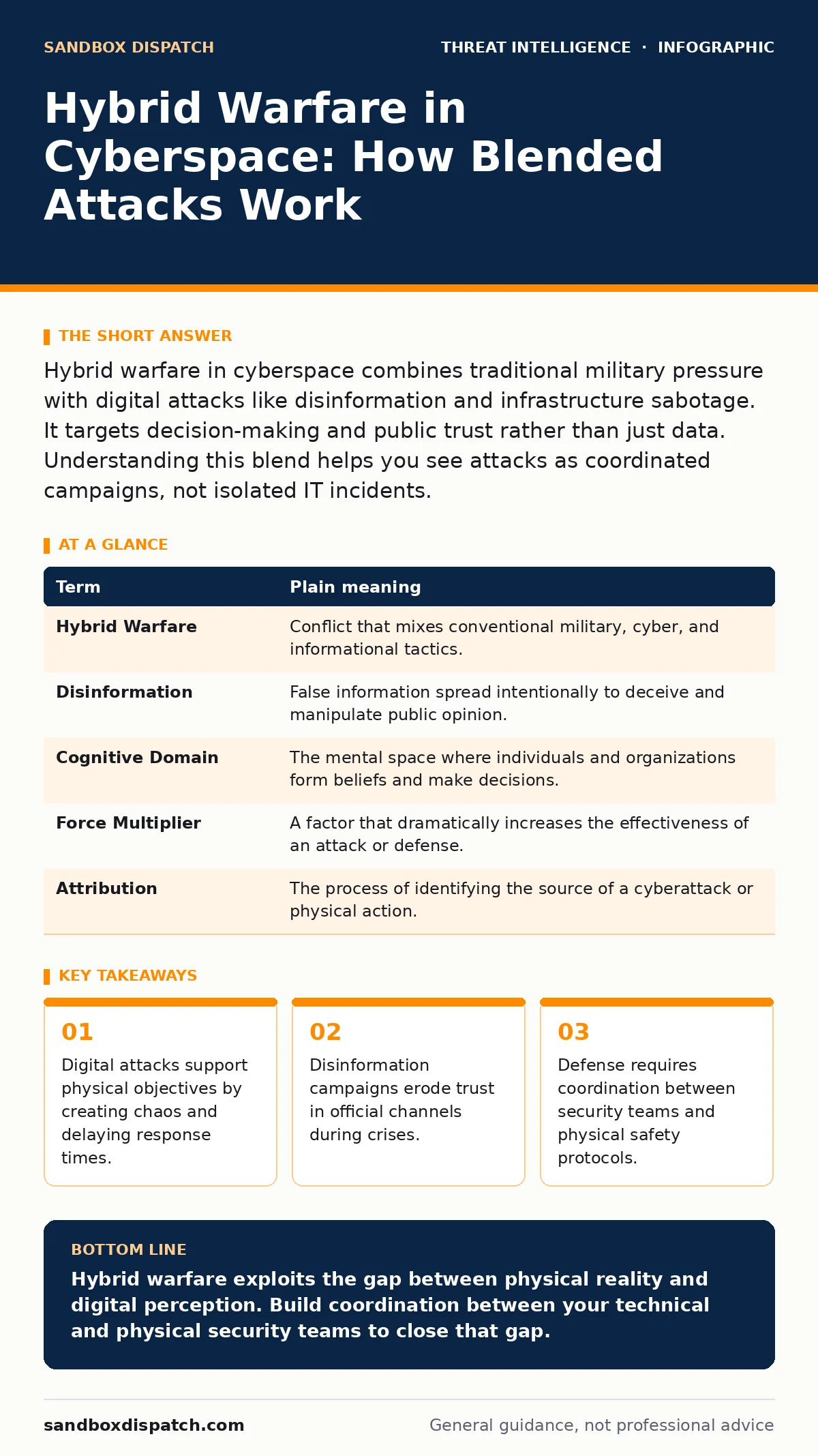
Hybrid warfare in cyberspace combines traditional military pressure with digital attacks like disinformation and infrastructure sabotage. It targets decision-making and public trust rather than just data. Understanding this blend helps you see attacks as coordinated campaigns, not isolated IT incidents.
The Blended Attack Model
Imagine a city facing a severe winter storm. The power grid fails, roads become impassable, and emergency services are overwhelmed. Now imagine that simultaneously, social media floods with false rumors about water contamination and government collapse. The storm is real. The rumors are fake. Both cause panic. Both prevent effective response. This is the core mechanism of hybrid warfare in cyberspace. It does not rely on a single vector. It relies on the synergy between physical constraints and digital confusion.
The attacker does not need to win every battle. They only need to create enough friction to paralyze decision-making. The physical event draws attention. The digital attack distorts reality. Together, they exhaust the target’s capacity to react. This approach exploits the natural delay between an incident occurring and the truth being verified.
Defining the Core Mechanics
Hybrid warfare operates across multiple domains simultaneously. To understand the threat, you must separate the components. Each element serves a specific purpose in the broader campaign. The digital layer often acts as a force multiplier for physical actions.
| Term | Plain meaning |
|---|---|
| Hybrid Warfare | Conflict that mixes conventional military, cyber, and informational tactics. |
| Disinformation | False information spread intentionally to deceive and manipulate public opinion. |
| Cognitive Domain | The mental space where individuals and organizations form beliefs and make decisions. |
| Force Multiplier | A factor that dramatically increases the effectiveness of an attack or defense. |
| Attribution | The process of identifying the source of a cyberattack or physical action. |
The Role of Information Operations
Information operations are not just about hacking servers. They are about hacking perception. Attackers use bot networks to amplify divisive narratives. They use deepfakes to discredit leaders. They use leaked documents to sow discord. The goal is to make the target population doubt their own institutions. When people do not trust their government or their news, they cannot coordinate a defense.
This creates a hidden cost for defenders. You cannot patch a lie. You cannot firewall a rumor. Once a narrative takes hold, it spreads faster than any correction. The technical team focuses on server integrity. The communications team focuses on public trust. In hybrid warfare, these two teams must work in lockstep. If they do not, the attacker wins by default.
Physical and Digital Synergy
The most dangerous aspect of hybrid warfare is the timing. A cyberattack on a power grid is less effective if done in isolation. It becomes devastating when paired with a physical protest or a natural disaster. The attacker waits for a moment of vulnerability. Then they strike. The digital attack exacerbates the physical crisis. The physical crisis validates the digital attack.
Consider a scenario where a transportation system is disrupted. If this happens during a period of high political tension, the disruption is viewed as an act of war. If it happens quietly, it is viewed as an accident. The context defines the impact. Attackers manipulate that context through digital means. They ensure the disruption is seen as intentional and malicious.
This synergy complicates incident response. A standard digital forensics and incident response plan addresses server outages. It does not address the social unrest that accompanies the outage. You must integrate physical safety assessments with your technical triage. Otherwise, you are fighting half the battle.
Common Points of Confusion
Many organizations confuse hybrid warfare with cyber espionage. Cyber espionage involves stealing secrets quietly. Hybrid warfare involves creating noise loudly. One is a stealth operation. The other is a spectacle. Confusing the two leads to wrong defenses. You do not stop a spectacle with a firewall. You stop it with clear communication and resilient infrastructure.
Another confusion is the belief that hybrid warfare is only for nation-states. While state actors have the most resources, the tactics are accessible. Any group can combine local physical disruption with digital amplification. The scale may differ, but the mechanics remain the same. Do not assume your organization is too small to be a target. The goal is often local chaos, not global domination.
See also: Digital Forensics Misconceptions That Derail Incident Response · Early Warning Signs of Cyber Espionage for Technical Teams
Building Resilience Against Blended Threats
Resilience is not about preventing all attacks. It is about maintaining function during an attack. You cannot stop all disinformation. You can ensure your critical systems remain online. You cannot stop all physical disruptions. You can ensure your backup generators work. The key is redundancy.
Start by identifying single points of failure. If a single communication channel goes down, can you still coordinate? If a single data center fails, can you still serve customers? Test these scenarios regularly. Use breach and attack simulation to test your technical defenses. Use tabletop exercises to test your communication plans. Both are necessary.
Immediate Actions for Teams
You do not need a massive budget to start preparing. You need clarity and coordination. Follow these steps to build a baseline of resilience.
- Audit Physical-Digital Links: Identify every system where a physical failure causes a digital outage, and vice versa. Document these dependencies.
- Create a Unified Response Plan: Ensure your IT team and your physical security team share a single incident response document. Define roles for both digital and physical crises.
- Test Communication Channels: Verify that you have offline methods to communicate with staff and customers. Assume all digital channels are compromised during a major event.
These steps address the intersection of the physical and digital. They prepare you for the confusion that hybrid warfare creates. They do not promise safety. They promise continuity.
Integrating Intelligence Sources
Intelligence is only useful if it is actionable. Raw data from threat feeds is not enough. You need context. You need to know how a digital threat connects to a physical risk. This requires a threat intelligence program that looks beyond IP addresses. It must analyze geopolitical trends and social unrest.
Integrate this intelligence into your daily operations. Do not keep it in a separate folder. Share it with the teams that manage physical access and digital access. When everyone sees the full picture, they can spot the early signs of a blended attack. This shared awareness is your best defense against confusion.
Key takeaways
- Digital attacks support physical objectives by creating chaos and delaying response times.
- Disinformation campaigns erode trust in official channels during crises.
- Defense requires coordination between security teams and physical safety protocols.
Hybrid warfare exploits the gap between physical reality and digital perception. Build coordination between your technical and physical security teams to close that gap.
Frequently asked questions
How do I distinguish hybrid warfare from a standard cyberattack?
Look for the intent to cause confusion or physical disruption. Standard attacks steal data or disrupt services. Hybrid attacks combine digital disruption with physical or social pressure to paralyze decision-making.
Is hybrid warfare only relevant to large governments?
No. Any organization with physical infrastructure and public-facing communications is a target. Attackers often target mid-sized organizations to create local chaos that has outsized political impact.
Can automation help defend against hybrid warfare?
Automation helps with speed but not with context. **SOAR** platforms can accelerate technical responses. They cannot interpret disinformation or manage physical safety. Human judgment is required for the blended aspects.
What is the first sign of a hybrid attack?
Look for simultaneous anomalies. A spike in network traffic combined with unusual physical activity or a surge in negative social media sentiment is a strong indicator. Isolated incidents are rarely hybrid attacks.
How this guide was produced: written by the Sandbox Dispatch editorial team with AI assistance, checked against the public references listed below, and reviewed when the facts change. See our editorial policy or report an error.